Contemporary Navajo Jewelry: The Evolution
The weight of vintage Navajo jewelry tells its own story. Heavy-gauge silver, substantial and unmistakable, carries the fingerprints of makers who understood that adornment was also armor, beauty was also power. These pieces—bracelets thick enough to withstand the elements, conchos wide as your palm, squash blossom necklaces that commanded attention—were born from sandcasting and tufa casting techniques that turned molten silver into wearable sculpture. The metal pooled into hand-carved molds, cooling into organic, slightly irregular forms that made each piece singular.
Route 66 became the artery through which this work flowed into the wider world, paved by the Santa Fe Railroad and Fred Harvey’s vision of bringing Native artistry to travelers through trading posts, pawn shops, and curios. The romance of the Southwest became inseparable from these pieces, and the Navajo silversmiths who created them became part of America's creative history.

Third Phase: Contemporary Navajo Jewelry Arrives
Now we're living in what collectors call the Third Phase—contemporary Navajo jewelry, roughly spanning from the 1970s to today. This era represents a dramatic evolution, not a departure. Where earlier periods were defined by the introduction of silversmithing itself (First Phase, mid-1800s) and the tourist boom of the early-to-mid 20th century (Second Phase), the Third Phase is characterized by technical refinement, artistic innovation, and a fierce commitment to both tradition and excellence. Native American jewelers are still here. They are still creating. And they have evolved. Contemporary Navajo artists are college-educated, internationally exhibited, and deeply rooted in their cultural inheritance. They're creating pieces that museums acquire, and collectors hunt for, work that stands confidently alongside any fine jewelry in the world while remaining — unmistakably, powerfully Navajo.
At Cowgirls & Indians, we work directly with these Third Phase master Diné silversmiths. Our Contemporary Navajo Jewelry capsule features pieces from renowned artisans like Lee Charley, whose work bridges generations of silversmithing knowledge with modern precision.
The New Luxury Standard
Here's what makes contemporary Navajo jewelry not just different, but better: it combines generational teachings with new-age innovations in ways that honor both. Modern artists are embracing the original techniques—sandcast, tufa cast, the stamps passed down through families—and elevating them with architectural precision. The tools are familiar—hammers, anvils, torches, the same implements their grandparents used—but the mastery has evolved into something extraordinary. The finish is mirrored perfection. Bezels are ultraclean, edges crisp. Updated polishing processes and techniques allow silver pieces to be better protected from oxidation over time. The makers intend for the pieces to be shiny. They're creating matching sets with tolerances that would make a Swiss watchmaker nod in respect. These artists are incorporating diamonds and gold, achieving symmetry that earlier makers might not have prioritized, bringing refinement and flawless craftsmanship.
What sets Navajo artisans apart in the world of fine jewelry is a rare duality: they are both master silversmiths and accomplished lapidaries. In 1880, Diné silversmith Atsidi Chon set a single piece of turquoise into silver—and in that moment, changed Navajo jewelry forever. While most jewelry traditions separate these disciplines—one artist cuts the stone, another sets it—Navajo jewelers command both crafts. When the same hands that will forge the silver bezel also cut and polish the turquoise, an intimate understanding develops between stone and setting. The artisan reads the raw material like a language, seeing not just what the stone is, but what it can become. This is especially critical when working with turquoise matrix—those distinctive veins and patterns that make each stone unrepeatable. A single millimeter's miscalculation while cutting can mean losing the matrix entirely. It requires not just technical skill but an almost preternatural ability to visualize the finished piece while staring at rough material.
This is the new luxury standard, and it's being set by Native hands using Native techniques refined to an almost impossible level of skill. Our Contemporary Navajo Jewelry exemplifies this evolution. These pieces are handcrafted on the Reservation in Navajoland, where artisans like Wyatt Lee-Anderson work with the same fundamental techniques their ancestors used, now refined to extraordinary mastery.
A Living Tradition
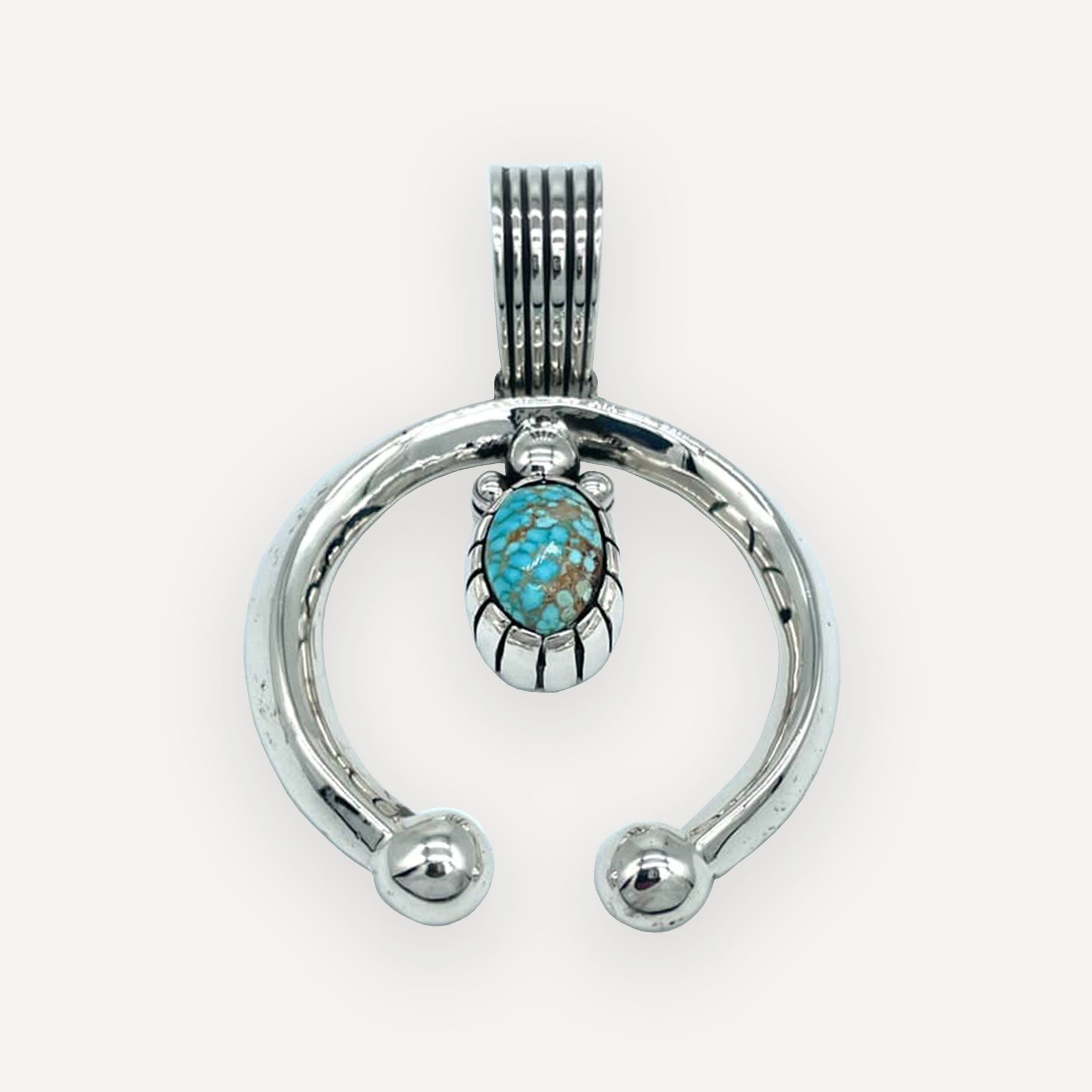
The beauty of contemporary pieces is how perfectly they complement vintage Navajo jewelry rather than competing with it. The old pieces are irreplaceable archives of technique and era. A collector with a Charles Loloma cuff from the 1970s can pair it with a contemporary Hat Band that speaks the same visual language but in a more refined accent. Both deserve a place in any serious collection. Both deserve to be worn, celebrated, and passed down. The old pieces bring history, patina, that organic irregularity that comes from being entirely handmade with period tools. The new pieces bring precision, brilliance, and technical achievement. They can be intermixed, layered, or stacked. A vintage Navajo Pearl necklace gains new dimension when worn with a contemporary Naja Pendant that echoes its same forms but executes them with modern mastery. Our Concho Belts are designed to layer seamlessly with both vintage and contemporary pieces—each concho hand-stamped with sacred silversmith artistry that remains the same past and present. The vintage pieces ground you in tradition; the contemporary pieces prove that tradition is alive. Together, they tell the complete story—where Navajo silversmithing has been, and where it's going.
Discover the Contemporary Navajo Jewelry Collection at CowgirlsIndians.com, where every piece is created by Diné artisans in Navajoland and crafted to last generations.